
3 Steps Towards Understanding Triangles
by Thomas, Jun 22 2022
Ask an adult 'what is a triangle?' and they'll have no trouble telling you that triangles have three sides and three angles. These attributes of a triangle are as familiar as an old friend; no surprises for us there. But for young children, making the connection between 'that pointy thing' and 'triangle' takes a little work.
Why can children easily identify triangles by pointing them out, but not describe the shape of a triangular object? Early childhood cognition of triangles is more than a matter of knowing what they're called - it's all about learning to establish the attributes of a triangle through multiple senses and being able to easily describe their characteristics in words. So how can you teach children to recognize triangles and to be able to describe their attributes accurately? Here are three ways to help you and your little one get started.
The Hands-On Approach
Young children learn best through real, physical contact with the subject they want to learn. A picture of a triangle is good, but a wooden triangle block is much better. Being able to feel the sides and angles of a triangle will form a strong mind-to-memory connection and begin to close the divide in their learning.
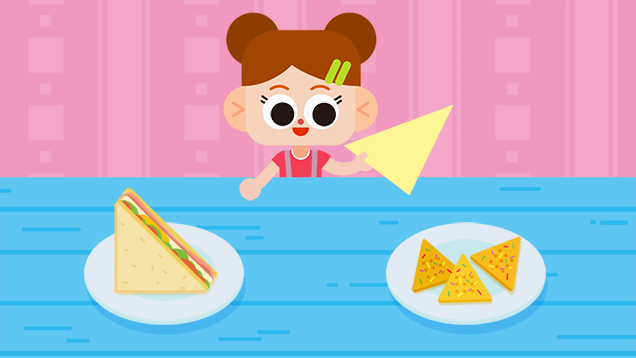
Give your child a shaped block, or even a piece of paper cut into shape. Ask them to touch the sides of the triangle, and then the angles. Let them perceive for themselves that the 'sharp and pointy' parts are corners, and the 'straight and long' parts are sides. Then ask how many sides and angles the shape has. Once done, take your child to find and explore triangular-shaped objects in real life, such as cookies, sandwiches, and road signs. It's through regular, on-the-go practice that their knowledge of shapes is continuously reinforced.
Describe, Compare, and Contrast
Does your child recognize an upside-down triangle as a triangle? If so, it's time to move up the difficulty on your practice time!
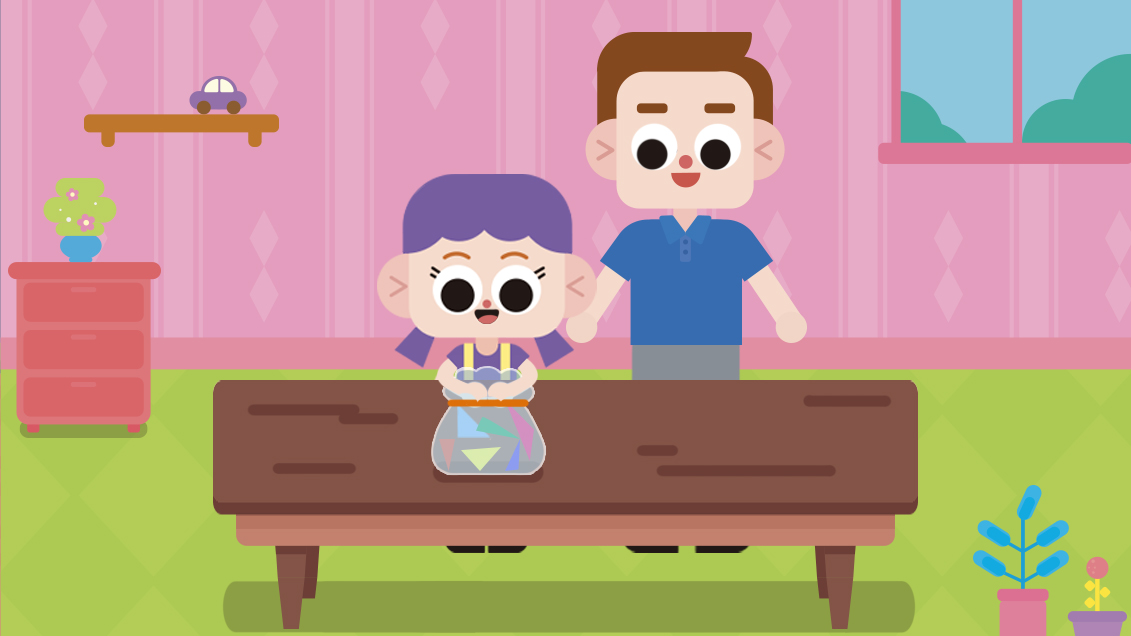
Grab a handful of differently shaped objects and place them in a bag that you can't see through, like a pillowcase. Have your child reach into the bag and feel one of the objects within, then ask them about it - what shape is it? How many sides does it have? How many angles? This activity lets children touch the shapes but not see them, calling on their mind-to-memory connection to recall the attributes of those shapes; that a square has four same-length sides and four corners, that a triangle has three sides and three corners, and so on.
Take each item out of the bag after your child answers questions about it. When all the items are out of the bag, guide them to compare and contrast two shapes at a time. You can ask questions like, how are these two different? How are they the same? They might start with simple answers: 'this is a square and this is a triangle.' Push them for a clearer answer - how do you know? 'Because the square has four corners, and the triangle has three.' This is a great time to introduce them to uneven triangles, too, and truly build on the foundation of attributes instead of appearance.
Get Messy, Make Mistakes
Your child is getting to know that a triangle has three sides and three angles, but still oversimplifies the details now and then; they see a slice of pizza as a triangle, for example. No problem - that's excellent progress! Still, as a parent, it's important to provide your child with correct information, and that means correcting their mistakes.
Start by showing your child that you understand what they mean, and then help them correct their errors in detail. "Yes, the pizza does look like a triangle, but it doesn't have straight sides here, does it?" The more comfortable you feel discussing shapes with your child in specific and precise terms, the more your child will follow your example and begin to try to describe shapes more precisely. Exposure to "wrong examples" can be a good way to help children understand and analyze the properties of triangles.